

Before the start of each school year, Belmont Day School faculty members sign up to cover a number of weekly duties, such as recess, lunch, or dismissal. These shared duties allow us to connect with and get to know students across different grades and colleagues with different job responsibilities.
Being new this year, I went with instinct when it came to signing up for my duties and challenged myself by taking the kindergarten rest duty two days each week. I wanted to immerse myself in an early childhood classroom, as I was just coming from a job focused predominantly on middle school-aged students. Also, I had just met our wonderful new kindergarten teachers, Lisa Wilson and Kristen Faubert, at our orientation, and I wanted to build rapport with them as a new teaching team.
Before my first duty with the kindergartners, I re-read the section on ages 5 and 6 in Yardsticks by Chip Wood. I highlighted the following words: “reassurance and routine,” “learning through doing,” and “high energy and movement,” wondering how they might reveal themselves during this thirty-minute block after lunch.
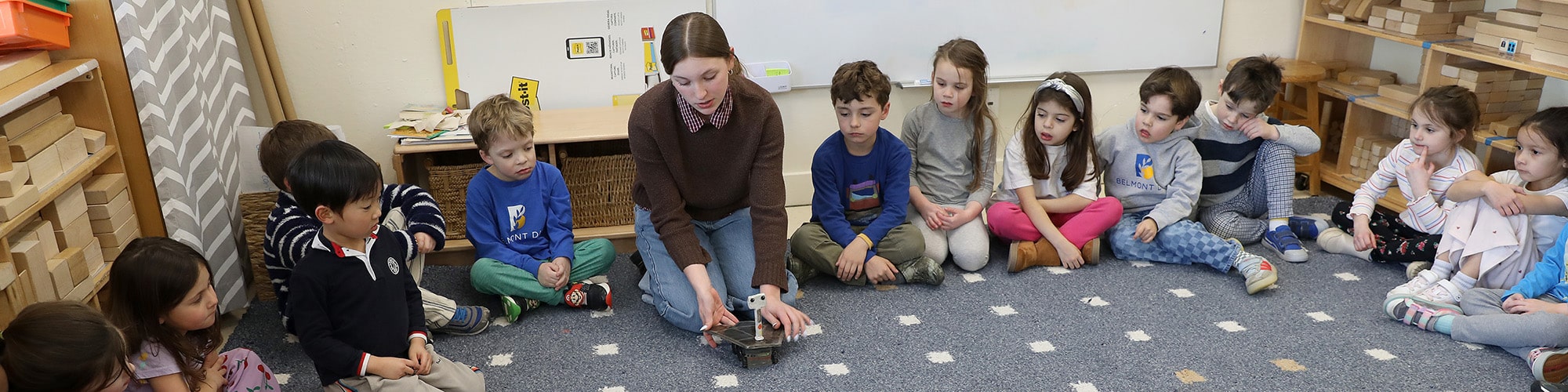
At 12:35, Ms. Faubert rang a chime and calmly announced the start of rest time. Students brought their rest mats and fuzzy blankets from their cubbies and sat in assigned spots. Some had their book baskets, while others focused on their stuffies: a fox, a pink cat, a small owl. My job was simply to redirect students when they talked with their peers or to help them switch their assigned spot if needed.
After a few weeks, it was clear that after lunch, the temptation to play animatedly or tell jokes to a friend was almost insurmountable. I relied on my Responsive Classroom training and took on the role of a ‘warm demander,’ redirecting students in affirming ways. I also started bringing in my own books to read. Students asked me questions about what I was reading, especially when I took notes on the pages, and told me when they liked the cover designs. Sometimes they even piled their stuffies around my books to keep them company when I was off helping another student.
In November, Lisa and Kristen reimagined the classroom’s daily schedule and moved recess to before what is now called “read and rest time.” This shift was in response to what they had observed in their students—a need to move and play more frequently during the school day, less inclination to take naps, and an increased desire to practice their growing reading skills. A few days into this new routine, I arrived to observe the children bounding into the classroom after recess, eager to settle into their books. Some found spots on the blue-and-white striped rug, away from the larger group, and read aloud at length for the first time. When bored with the books they had already read, we encouraged them to find new ones in the classroom. Around 12:48, 15 minutes into read/rest time, the classroom hummed with the collective energy of students doing what they needed individually.
There are many truths and lessons in this experience thus far. The first is that change is always possible. I respect Lisa and Kristen for advocating for what their students needed and, with Lower School Head Betty Chu Pryor’s support, making it happen. They are remarkable educators who are keenly focused on their students’ growth and well-being.
Second, each of us can learn by doing. As a former middle school teacher and division head, I had not spent much time in a kindergarten classroom until this year. I learned by observing how the teachers engaged the students, and they helped me see how I could contribute. A month in, I was able to greet the kindergartners during my other duty at morning arrival in a more connected way, knowing that I would see them later that day and learn about topics as wide-ranging as cooking, tigers, and construction vehicles through the books they had chosen.
And finally, the experience has reminded me of my own post-pandemic decision to carve out quiet reading time in my former seventh grade English classes, which felt like a bold move at the time. All of us can benefit from structured time to read and to make choices about what we need most from quiet time, regardless of our age.
The premise of presence, as represented by a sign-up slot on our duties calendar, offers a tremendous opportunity to learn, connect, and create impact. It is one of the many ways that we inspire and challenge our students—and ourselves—at Belmont Day.
