Groove to the Beat: Bucket Drumming Elective
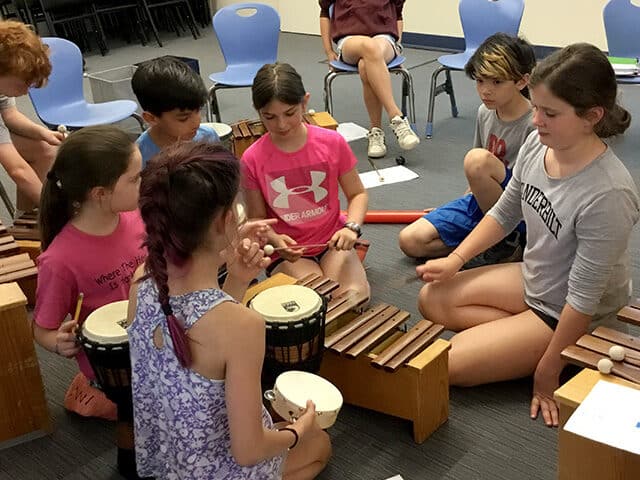
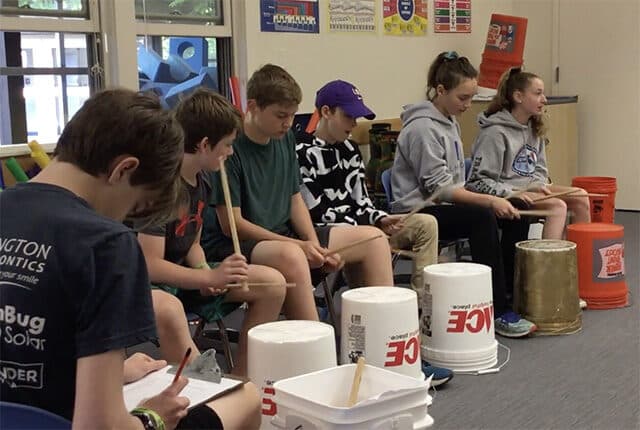
This week, students in the grades 7 and 8 bucket drumming elective class performed their final drumming routine for the Belmont Day community. In the seventh and eighth grades, students learn more complex drumming technique and choreography that build on techniques used in sixth grade. Students work on drag ruffs, paradiddles, as well as choreography that allows for line and circle formations. They came up with a routine that consists of four one-minute sections, comprised of at least two types of drumming strokes, and one type of choreography.
According to a 2013 study, group drumming improves the social and mental wellbeing of at-risk students. The implication of the study is that group drumming improves self-esteem as well as nonverbal communication of students. Furthermore, small drumming groups can improve group cohesiveness and mood. It has been absolutely phenomenal and a privilege to witness the musical and social growth of our students in music class. They not only work on nonverbal cues and rhythmic accuracy but on social bonding and interaction. Check out this performance video to see the students in action!
More Arts News
Fourth grade students have been working on graphic notation through the study of minimalist composers such as Steve Reich, Philip Glass, and Arvo Part for our final unit of the year. For their project, students walked around to observe the sounds of BDS, and create a composition using layering, shapes, and abstract art.