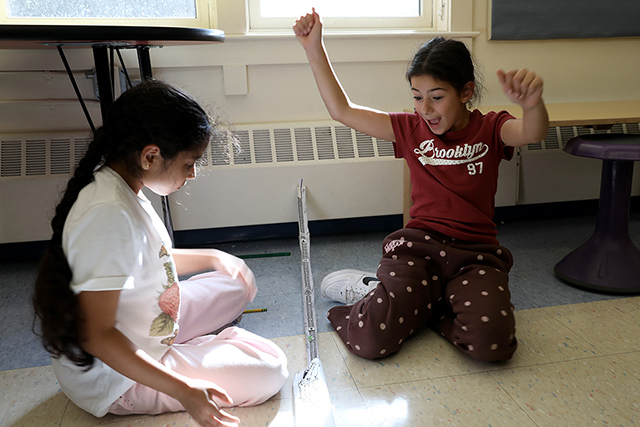
A seemingly simple warm-up exercise in a recent seventh grade math class posed the question, “For each pair of shapes, decide whether or not they are the same.” This warm-up should take 2 or 3 minutes. Instead, when they checked in with their groups, students realized they each had been working with their own interpretation of what “the same” meant. This led to disagreements. For example, some felt that the two shapes in B were “the same” because they were both parallelograms. In fact, in earlier grades, deciding if two shapes are the “same” usually involves making sure that they are the same general shape (for example, triangles or circles). As shapes become more complex and students work with increasingly abstract concepts, they need more precise mathematical language.
This seemingly simple task bloomed into a rich, sometimes heated discussion in which students supported their choices with their own definition of “the same.” From these productive arguments, they called for a clearer, more detailed definition that everyone could agree on. Ta-dah! We introduced the word congruent, and students immediately wanted a precise definition so we could use the term with a shared understanding.
I chose to present this problem before formalizing the definition so my students could experience the limitations and frustrations of vague or undefined terms. They are then highly motivated to develop stronger and more precise definitions that take into account the increased complexity of the concepts. After much debate and deliberation, the students came up with the following: Two shapes are congruent if a sequence of rigid translations, rotations, and reflections maps one shape onto the other, so corresponding parts have equal measure. This is a more rigorous definition than the seventh grade standards, but the students pushed for clarity and precision. One of the Standards of Mathematical Practice states, “Attend to precision.” They certainly did!